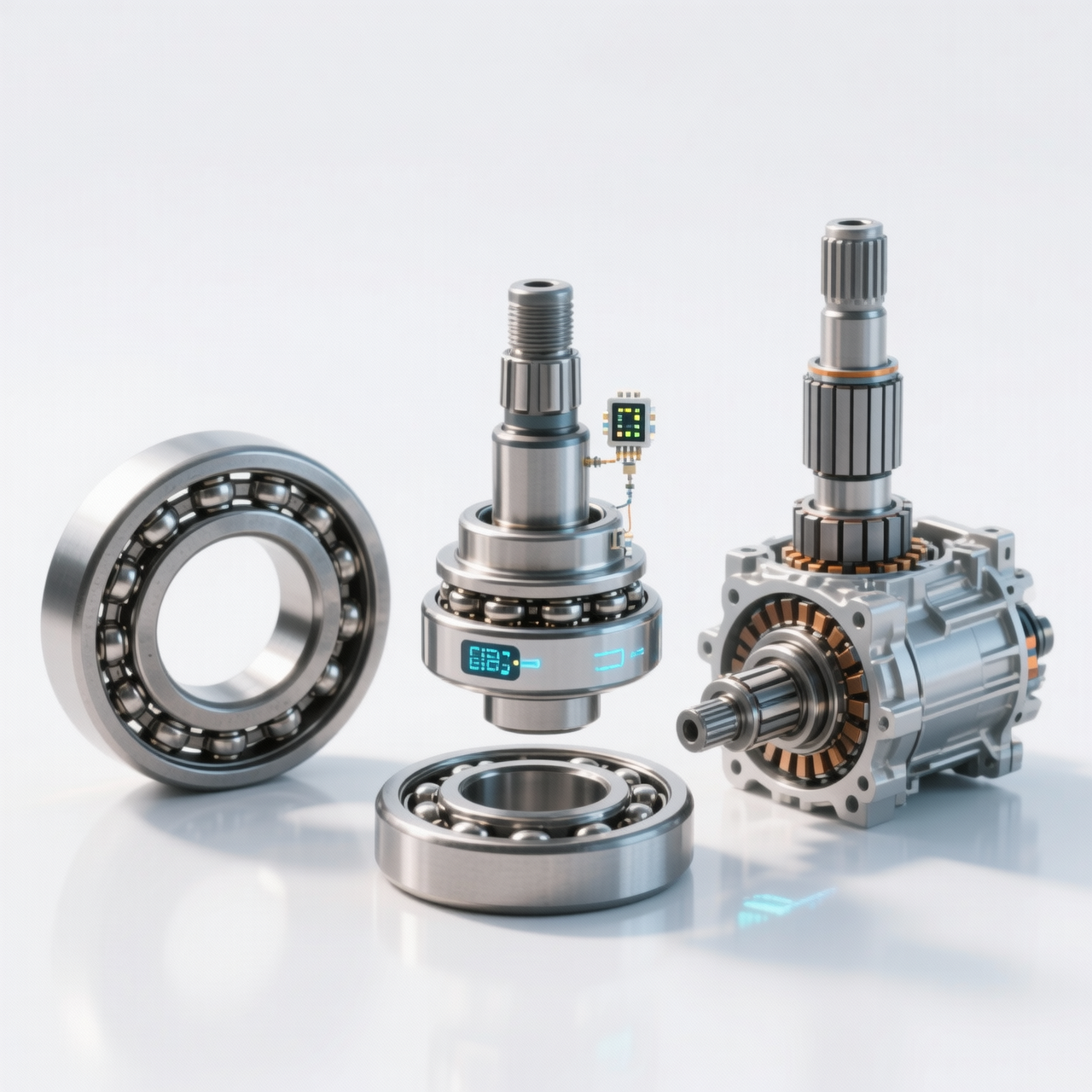
According to the newly released "2024-2030 China Automotive Bearing Industry Market Outlook and Investment Strategy Report," the bearing industry, deeply intertwined with the automotive industry's comprehensive transformation towards electrification and intelligentization, is undergoing a profound paradigm shift. The report predicts that by 2030, the Chinese automotive bearing market is expected to exceed 120 billion RMB, with new energy vehicle bearings accounting for over 60%, becoming the absolute growth driver.
The report points out that the market landscape is undergoing structural changes:
Upgraded Demand: Electric vehicles place complex demands on bearings, requiring higher speeds (motor bearings exceeding 20,000 rpm), lower frictional losses (improving energy efficiency), stronger axial load capacity (coping with high torque), and superior NVH performance. Traditional standardized bearings are no longer sufficient, leading to a surge in demand for customized, high-value-added products.
Supply Chain Restructuring: To ensure supply chain security and responsiveness, domestic vehicle manufacturers, especially emerging electric vehicle startups, are actively supporting local core component suppliers. A number of Chinese bearing companies possessing core capabilities in materials science, precision machining, and simulation testing are successfully penetrating the high-end supporting system, steadily increasing their market share by leveraging their rapid iteration and service advantages.
Technological Convergence Trend: Bearings are no longer viewed as isolated components. Integrated sensors (“smart bearings”) monitor temperature, vibration, and load conditions in real time, enabling predictive maintenance; integrated designs with motor and reducer housings (“unitized bearings”) to save space and weight are becoming the main direction of technological evolution in the industry.
Industry experts analyze that, "In the past, the automotive bearing market was a competition of scale and cost. In the future, it will be a contest of technological solutions and collaborative R&D capabilities. Suppliers who can provide OEMs with integrated services of 'bearing + sensing' and 'bearing + simulation analysis' will occupy a more advantageous position in the value chain."
Currently, leading domestic bearing companies have increased their investment in R&D, established national-level laboratories, and formed joint development teams with universities and OEMs, focusing on the engineering application of cutting-edge technologies such as ceramic hybrid bearings and magnetic levitation bearings, aiming to achieve a leap from "following" to "keeping pace" and even "leading" in the global automotive industry transformation.
Related Posts
- ▶ From "Mechanical Components" to "Data Nodes": Redefining Automotive Bearings in the Era of Intelligent Connectivity
- ▶ The Shanghai International Automotive Bearing Technology Forum concluded successfully, jointly outlining a blueprint for collaborative innovation within the industry.
- ▶ Driven by both electrification and intelligentization, China's automotive bearing market is poised to enter a new blue ocean worth hundreds of billions of yuan.
Online Message
Thank you very much for writing to us. Please leave your message and contact information, we will reply to you within 24 hours.